

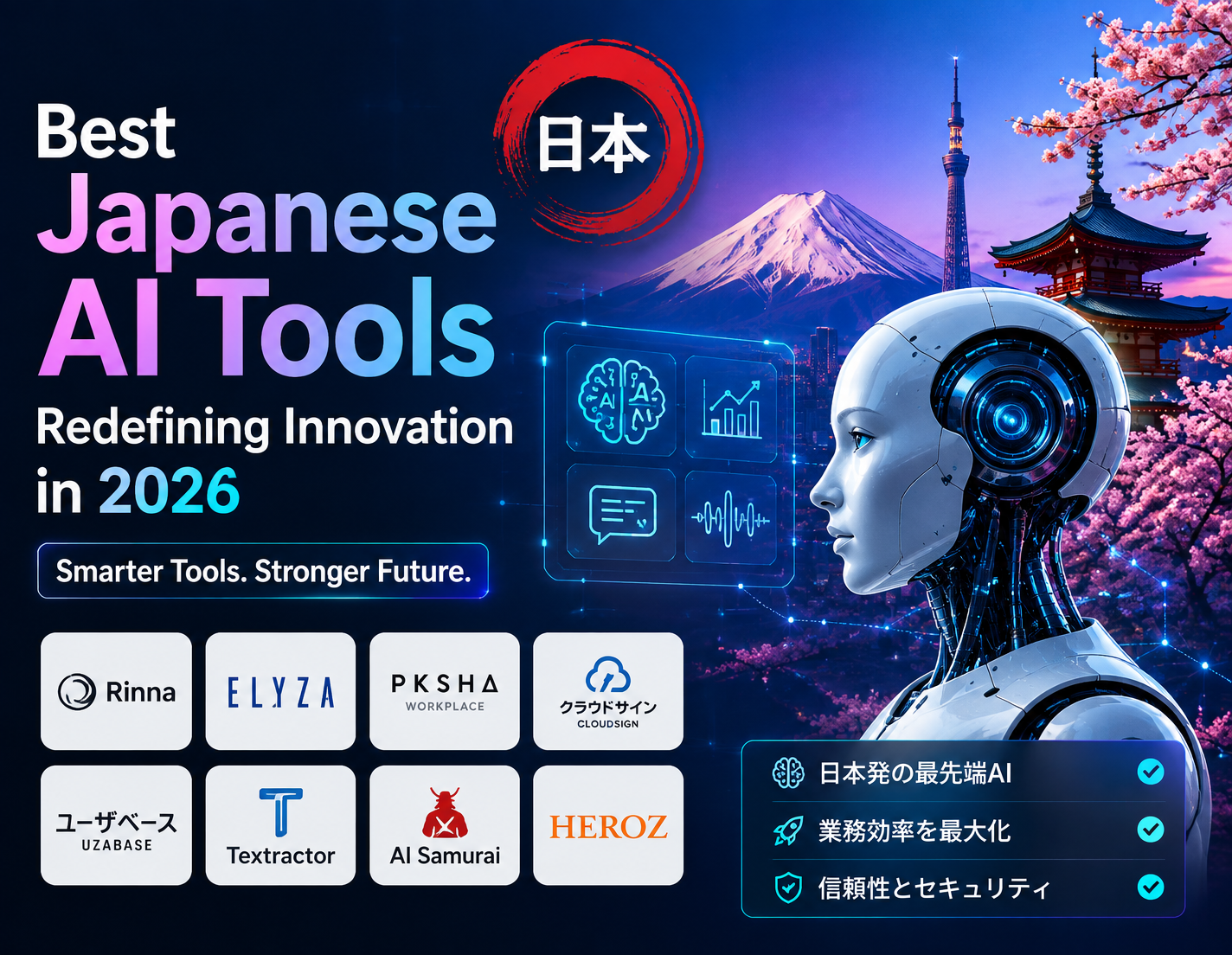
Japan’s best AI tools in 2026 span language models, robotics, creative software, and business automation. Standouts include Preferred Networks’ deep learning platforms, SoftBank-backed conversational AI, Sony’s creative AI systems, and NTT’s tsuzumi language model. These tools blend precision engineering with practical utility, making Japan a quiet but formidable force in global artificial intelligence.
Japan has long been associated with robotics, precision manufacturing, and consumer electronics. What often goes unnoticed is how deeply the country has invested in artificial intelligence—and how that investment is now bearing fruit. From Tokyo research labs to startups in Osaka and Fukuoka, Japanese companies are building AI tools that solve real problems in language, healthcare, industry, and creativity.
This guide walks through the most impressive Japanese AI tools shaping the landscape today. You’ll learn what each tool does, who it’s built for, and why it stands out in a market dominated by American and Chinese platforms. Whether you’re a developer, a business owner, or simply curious about where AI is headed, this overview will give you a clear picture of Japan’s growing role in the field.
By the end, you’ll understand not just the individual tools but the philosophy behind them: a focus on reliability, cultural nuance, and applications that genuinely improve how people live and work.
Why is Japan becoming a serious player in artificial intelligence?
Japan’s approach to AI reflects its broader engineering culture. Rather than chasing hype, Japanese developers tend to prioritize accuracy, safety, and long-term usefulness. This is partly a response to national challenges. With one of the world’s oldest populations and a shrinking workforce, Japan needs AI to fill gaps in healthcare, elder care, logistics, and manufacturing.
The government has backed this push with substantial funding. Japan’s national AI strategy encourages collaboration between universities, corporations, and startups. The result is a steady stream of practical tools rather than flashy demos that fizzle out.
Language is another driver. Most large language models are trained primarily on English data, which leaves Japanese users underserved. Homegrown models trained on Japanese text handle the language’s grammar, honorifics, and cultural context far better than generic alternatives. That gap has created a strong incentive for domestic innovation. For a broader look at how these trends fit into the global tech picture, TechBullion regularly covers emerging AI developments across markets.
What are the top Japanese AI language models worth knowing?
Language models sit at the heart of the current AI boom, and Japan has produced several impressive contenders.
NTT’s tsuzumi is one of the most notable. Developed by telecommunications giant NTT, tsuzumi is a lightweight large language model designed to run efficiently while excelling at Japanese-language tasks. Its smaller footprint means it can operate on modest hardware, which makes it attractive for businesses that want to keep data in-house rather than relying on cloud services abroad.
Fujitsu’s Takane is another strong entry. Built in partnership with Canadian AI firm Cohere, Takane targets enterprise clients who need secure, high-accuracy language processing for Japanese business documents. It’s aimed squarely at industries like finance and government, where privacy and precision matter more than raw scale.
Rakuten AI rounds out the group. The e-commerce and fintech giant has developed models tuned for Japanese retail and customer service, helping merchants automate support and personalize recommendations. Choose Rakuten AI if you operate in Japanese e-commerce and want tools already integrated with a familiar ecosystem.
Which Japanese companies lead in AI-powered robotics?
Robotics is where Japan’s AI reputation was built, and the country continues to lead here.
Preferred Networks, often called Japan’s most valuable AI startup, develops deep learning systems that power industrial robots, autonomous machines, and medical imaging tools. Its collaboration with automation firm FANUC has produced robots that learn tasks through trial and error rather than rigid programming. This matters for factories that need flexible, adaptable machines.
SoftBank Robotics created Pepper, the humanoid robot that became a global talking point. While Pepper’s commercial run had mixed results, SoftBank continues to refine conversational and service robotics, focusing on retail, hospitality, and elder care.
Sony deserves a mention too. Beyond its famous aibo robot dog—which uses AI to develop a unique personality over time—Sony’s AI division works on reinforcement learning research, including systems that have beaten human champions in racing video games. These experiments feed directly into real-world robotics and autonomous systems.
What creative and entertainment AI tools come from Japan?
Japan’s creative industries have embraced AI in ways that reflect the country’s strengths in gaming, animation, and design.
Sony’s Gran Turismo Sophy is a landmark example. This AI agent learned to outrace top human drivers in the popular racing simulator, demonstrating advanced decision-making under pressure. The technology has applications well beyond gaming, informing how autonomous vehicles might handle split-second choices.
For content creators, several Japanese startups offer AI illustration and animation tools tuned for anime and manga aesthetics. These platforms understand the visual language of Japanese art in ways general-purpose Western tools often miss. Artists exploring these tools frequently share their workflows and results, and platforms like Founder Stories document how creators and entrepreneurs are turning these tools into viable businesses.
Music generation is another growing area, with Japanese developers building AI systems that compose in styles ranging from traditional to contemporary J-pop.
How are Japanese AI tools used in business and everyday life?
The most compelling story about Japanese AI may be its quiet integration into daily operations.
In healthcare, AI diagnostic tools help radiologists spot anomalies in scans, easing the burden on a stretched medical workforce. In logistics, companies use AI to optimize delivery routes and warehouse operations, a necessity given Japan’s labor shortages.
Customer service has been transformed too. Japanese chatbots and voice assistants handle the language’s layered politeness levels with a nuance that generic tools struggle to match. This makes them genuinely useful in a culture where the right level of formality carries real weight.
For small businesses and startups looking to adopt these tools, the barrier to entry keeps dropping. Cloud-based AI services now let a single-owner shop access capabilities that once required a dedicated tech team. Resources that track startup adoption and growth strategies, such as those featured on Trafily, offer useful context for entrepreneurs weighing which tools to try first.
How do Japanese AI tools compare to global alternatives?
Japanese AI tools rarely try to out-scale American giants like OpenAI or Google. Instead, they compete on specialization and trust.
Choose a Japanese AI model if your work involves the Japanese language, requires strict data privacy, or targets Japanese consumers. The cultural and linguistic accuracy these tools offer is hard to replicate. Choose a global platform if you need the broadest possible general knowledge, multilingual reach, or the largest developer community.
The gap in raw model size is real, but it matters less than many assume. For most business tasks—drafting documents, answering customer questions, analyzing local data—a well-tuned domestic model often outperforms a larger foreign one. Efficiency and fit frequently beat sheer size.
Frequently asked questions
What is the best Japanese AI language model in 2026?
There’s no single winner, since the best choice depends on your needs. NTT’s tsuzumi is ideal for efficient, on-premise Japanese language tasks. Fujitsu’s Takane suits enterprises needing secure document processing. Rakuten AI works best for e-commerce and retail applications.
Are Japanese AI tools available outside Japan?
Some are, though availability varies. Sony’s AI research and Preferred Networks’ technology reach global markets through partnerships and products. Many language-focused tools, however, are optimized for Japanese users and may have limited international support or interfaces.
Why does Japan build its own AI models instead of using existing ones?
Japan builds domestic models mainly for language accuracy and data privacy. Global models trained mostly on English data handle Japanese grammar, honorifics, and cultural nuance poorly. Domestic models also let companies keep sensitive data within national borders, which matters for finance and government.
Are Japanese AI tools good for small businesses?
Yes. Cloud-based Japanese AI services have made advanced tools affordable for small businesses. Owners can automate customer support, personalize marketing, and streamline operations without hiring a technical team, which is especially valuable given Japan’s labor shortages.
What makes Japanese robotics AI different?
Japanese robotics AI emphasizes learning and adaptability rather than fixed programming. Companies like Preferred Networks build robots that learn tasks through trial and error, while Sony and SoftBank focus on service and companion robots designed for real human interaction.
Where Japan’s AI journey goes from here
Japan’s AI story is one of substance over spectacle. The tools coming out of the country aren’t always the loudest, but they’re often the most reliable and thoughtfully designed. As demographic pressures mount and the demand for practical automation grows, expect Japanese AI to become even more central to how the country lives and works.
If you’re considering adopting any of these tools, start by matching the tool to your specific need—language, robotics, creative work, or business automation—rather than chasing the biggest name. Test a domestic model against a global one on your actual tasks, and let the results guide your choice. The best AI tool is the one that fits your problem, and Japan increasingly has an answer worth considering.
